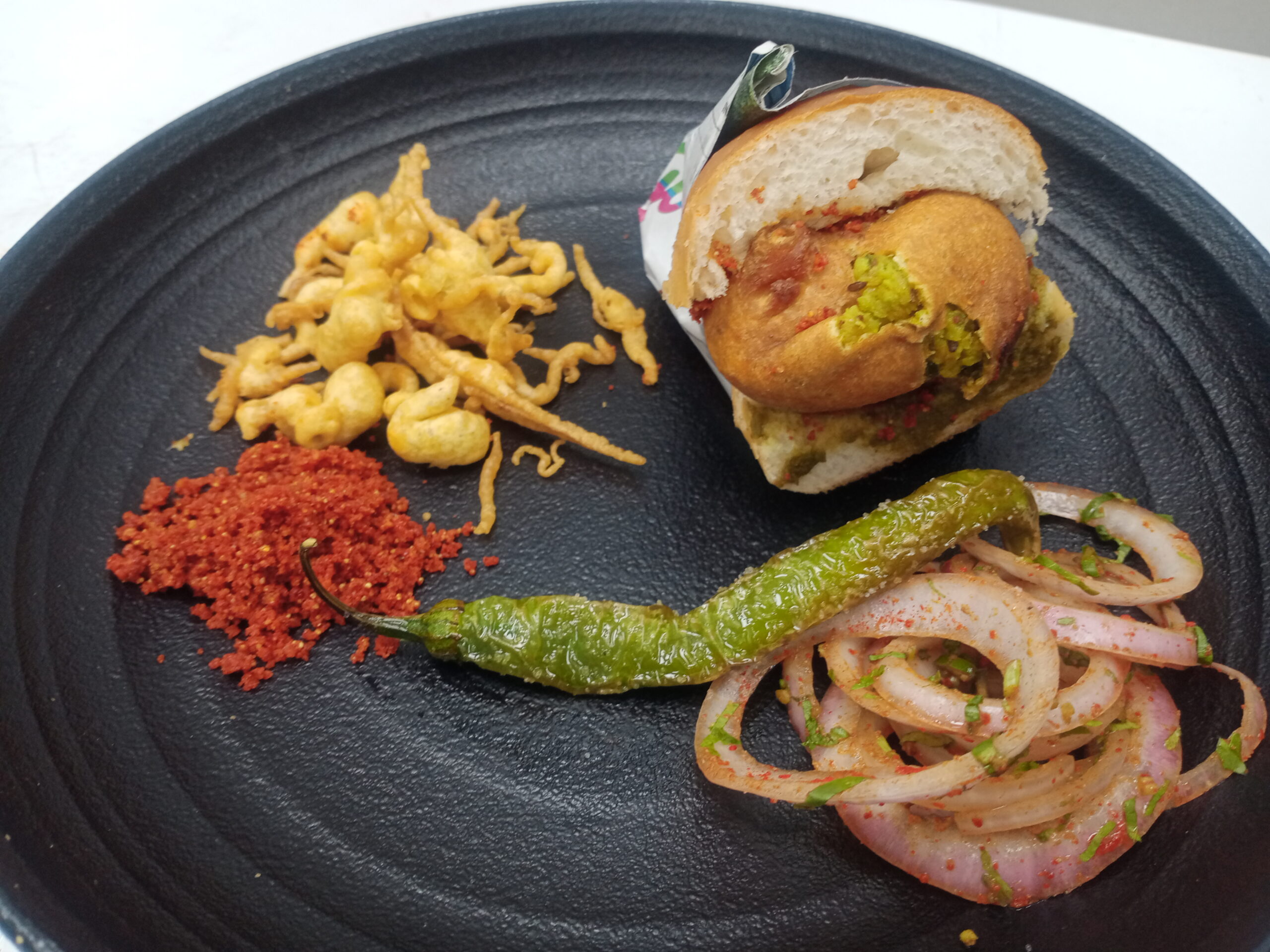
I need to tell you something that might sound strange coming from a pastry chef who has spent years making French croissants and Italian entremets: the most perfectly engineered food I’ve ever eaten is vada pav. Yes, vada pav. Mumbai’s humble, ₹20 street food masterpiece that feeds millions of people every single day without asking for applause.
And I’m not saying this to be cute or controversial. I’m saying it because as a chef who has studied flavour, texture, and composition, vada pav is genuinely brilliant food engineering disguised as something simple.
The Architecture of Perfection
Let me break it down the way a chef sees it. You’ve got a pav — soft, slightly sweet bread that acts as the vessel. Inside, a vada — spiced potato, coated in besan batter, deep fried until the outside is crispy and the inside is fluffy. Then the chutneys: a fiery dry garlic chutney (the red powder that stains your fingers), a green chilli-coriander chutney, and sometimes a sweet tamarind one.
Now think about what’s happening in your mouth. You’ve got soft (pav) against crispy (vada coating). You’ve got starchy (potato) against tangy (chutney). You’ve got heat from the chilli, sweetness from the pav, sourness from the tamarind, and that deep umami-like savour from the hing and curry leaves in the vada filling. In culinary school, they teach you to balance these elements. The vada pav vendor outside Dadar station figured it out without ever reading a textbook.
The first time I really understood vada pav — not just ate it, but understood it — was outside Churchgate station at 7 AM after an overnight train from Goa. I was hungry, tired, carrying a bag that weighed more than me, and a man handed me a vada pav wrapped in newspaper. I took one bite and thought: this is the most honest food in the world. No pretence. No garnish. Just pure, unapologetic deliciousness.
The ₹20 vs ₹2000 Debate
Here’s what I find fascinating. I’ve eaten at restaurants that charge ₹2000 for a single dish. Beautiful plating, imported ingredients, techniques borrowed from Michelin-starred kitchens. And some of them are genuinely outstanding. But none of them — not one — has ever given me the same satisfaction-per-rupee as a well-made vada pav.
I’ve even seen hotels try to make “gourmet vada pav.” They use truffle oil, artisanal bread, fancy potato varieties. And it always misses the point. Because vada pav isn’t about the ingredients being expensive. It’s about the ratios being perfect. The exact thickness of the besan coating. The exact amount of green chilli in the chutney. The exact softness of the pav — not too fresh (it’ll fall apart) and not too stale (it’ll fight you).
The street vendors have perfected these ratios through thousands of repetitions. They make hundreds of vada pavs a day, every day. That kind of practice creates mastery that no culinary degree can shortcut.
What Vada Pav Taught Me About My Own Cooking
When I was working at one of the hotels in Mumbai, I used to go to the same vada pav stall every evening after shift. The guy — I never learned his name, which I regret — knew me by face. He’d see me in my chef’s uniform and always give me an extra chilli on the side. One day he asked me what I cooked. I told him I was a pastry chef, that I made cakes and croissants and French desserts.
He nodded, thought about it, and said — “French? Why? Our food is better.” He said it without arrogance. Just as a fact. Like telling me the sky is blue.
And you know what? He wasn’t entirely wrong. I don’t think Indian food is better or worse than French food — they’re different traditions, different philosophies. But his confidence in his own food, his refusal to see it as lesser just because it was cheap and came in newspaper instead of on a white plate — that stuck with me.
It made me think about my own approach to Indian flavours in pastry. Why was I treating cardamom as an “exotic” addition to French recipes instead of treating it as the star? Why was I deconstructing gulab jamun to make it “modern” when gulab jamun is already perfect? That vada pav vendor’s quiet pride in his craft gave me permission to be proud of mine — and to stop treating Indian ingredients as guests in a European kitchen.
The Perfect Vada Pav — A Chef’s Notes
If you want to make vada pav at home — and you should — here’s what matters. The potatoes need to be boiled until just done, not mushy. Mash them with your hands, not a machine — you want some texture. The tempering must have mustard seeds, curry leaves, hing, green chillies, and turmeric. This is non-negotiable.
The besan batter should be slightly thick — it needs to coat the vada and stay on during frying. Add a pinch of baking soda for extra crispness. Fry in oil that’s hot enough — if the vada sinks and doesn’t come up within five seconds, your oil is too cold. If it immediately browns, too hot. You’re looking for a gentle sizzle and a slow rise to the surface.
The dry chutney — roasted garlic, dry coconut, red chilli powder, salt — this is the soul of the whole thing. Don’t skip it. Don’t substitute it. This powder is what separates a good vada pav from a great one.
And please — eat it with your hands. Standing up. Preferably near a train station with a cup of cutting chai in the other hand. That’s not tradition, that’s engineering. Vada pav was designed to be eaten on the go, by people who are busy living their lives. It’s Mumbai’s most democratic food because it doesn’t care who you are. CEO or cab driver, you’re both eating the same thing, in the same newspaper, with the same look of contentment.
That’s culinary mastery. No Michelin star required.