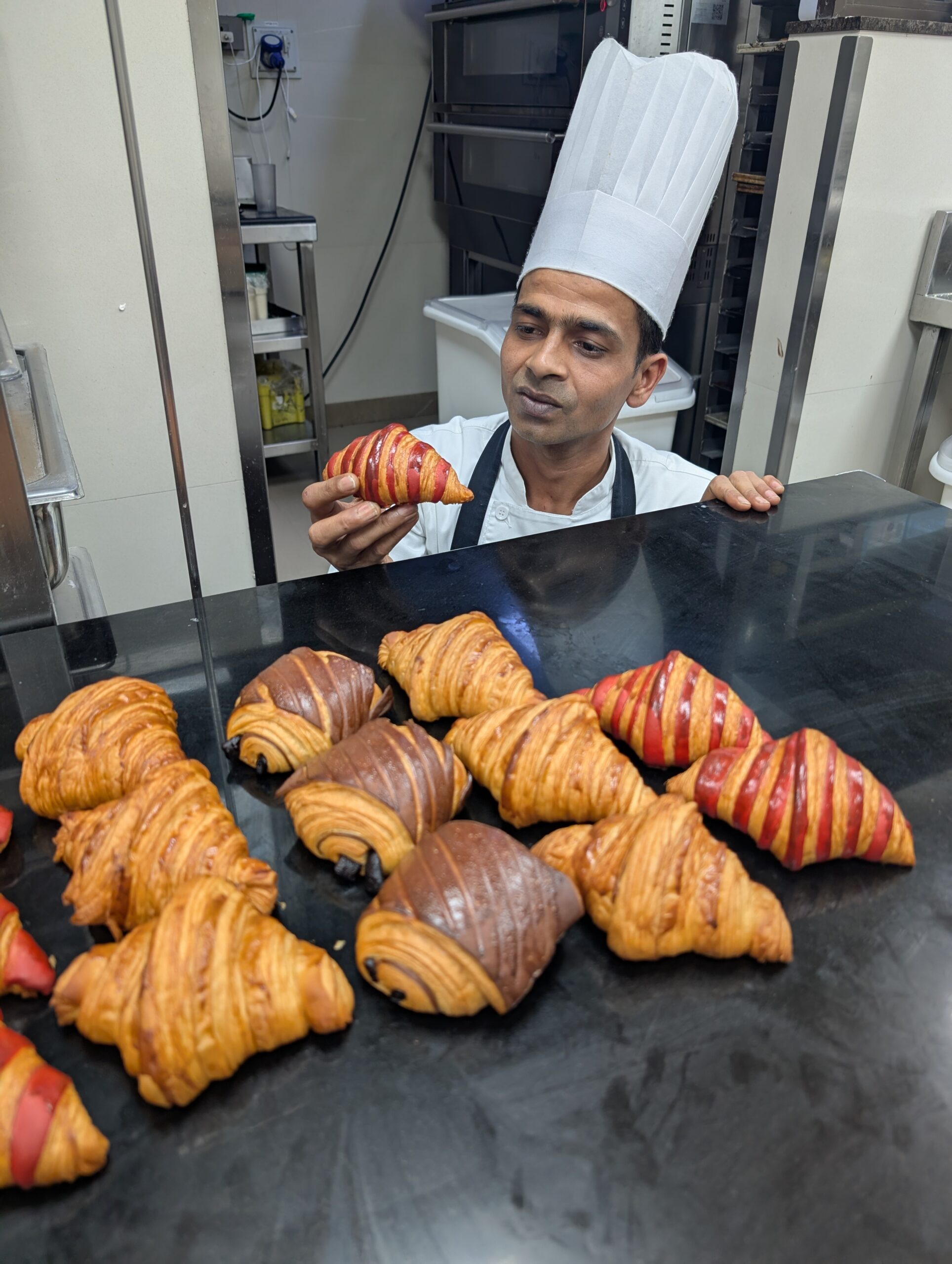
I’ll be honest — when I first had the idea to put cardamom in a croissant, even I thought it was a bit mad. Croissants are sacred in the pastry world. French bakers have spent centuries perfecting the lamination, the butter ratio, the exact number of folds. And here I was, a Rajasthani boy in a Goa hotel kitchen, thinking: what if I added elaichi?
But the thing about being a chef who grew up eating Indian sweets and then trained in European pastry is this — your brain makes connections that a purely French-trained or purely Indian-trained chef might not. And the connection my brain made was simple: cardamom and butter are old friends. They’ve been hanging out in Indian desserts for centuries. Ghee and elaichi in every halwa, every ladoo, every barfi. So why wouldn’t cardamom love butter in a croissant?
The First Attempt (A Beautiful Disaster)
My first attempt was terrible. I ground whole cardamom pods — green ones — and mixed the powder directly into the détrempe (that’s the flour-water-yeast dough that gets wrapped around the butter block). The problem? Too much. Way too much. The croissant tasted like someone had emptied a spice box into it. My colleague took one bite, made a face, and said, “Bhai, this is a croissant or a chai latte?”
Fair point. Fusion is not about dumping one cuisine into another. It’s about understanding both cuisines deeply enough to know where they naturally overlap. So I went back to basics. How much cardamom does a good kheer use for a litre of milk? A few pods. Subtle. A whisper, not a shout.
For my second attempt, I infused the butter block instead. I gently warmed the butter with crushed cardamom pods, let it steep like tea, then strained it, rechilled it, and sheeted it as normal. The result? The cardamom was there, but gently. Like a memory. You’d take a bite, taste butter and flaky pastry, and then — almost as an afterthought — this warm, floral note of elaichi would appear. Like it had always belonged there.
The executive chef tried one and went quiet for a moment. Then he said, “Do twelve for tomorrow’s breakfast. Let’s see what the guests think.” That was the highest compliment in a hotel kitchen — not “well done,” but “make more.”
Why Cardamom and Butter Work Together
Let me put on my food science hat for a moment. Cardamom contains a compound called 1,8-cineole, which is slightly cooling and aromatic. Butter is rich in fat-soluble flavour compounds. When you combine them, the fat in the butter carries the cardamom aroma more effectively — it amplifies it without concentrating it. That’s why cardamom in ghee-based sweets is so effective, and why it works in butter-laminated pastry too.
It’s the same principle behind vanilla in French pastry, actually. Vanilla is warm, floral, and fat-soluble. Cardamom occupies a similar flavour space — warm, floral, slightly sweet — but with more complexity. If the French had grown cardamom instead of importing vanilla from Madagascar, I genuinely believe croissants would have been cardamom-flavoured from the beginning.
The Guest Reactions
The first morning we put cardamom croissants on the breakfast buffet, I stood near the pastry station pretending to arrange things while actually watching guests’ faces. Most people picked up a regular croissant — it’s what they know. But a few adventurous souls tried the new one.
An older French couple — and I swear I’m not making this up — took one bite, looked at each other, and came back for seconds. The gentleman asked me what was in it. When I said cardamom, he nodded slowly and said, “C’est intelligent.” That’s intelligent. From a Frenchman. About a Rajasthani boy putting Indian spice in his national pastry. I’ll take that compliment to my grave.
Indian guests loved it too, but differently. For them, it was recognition. “It tastes like home,” one woman told me. “Like my mother’s chai, but in a croissant.” That’s exactly what I was going for — that feeling of familiarity wrapped in something unexpected.
The Rules of Fusion (According to a Chef Who Gets It Wrong Sometimes)
This experiment taught me something important about fusion cooking that I carry to this day. Fusion isn’t about being clever. It’s about being respectful. You have to understand the French croissant — why the butter content is specific, why the folds matter, why the proofing temperature is critical — before you can add anything to it. And you have to understand cardamom — its intensity, its behaviour in fat, its cultural significance in Indian cooking — before you can put it somewhere new.
Bad fusion takes shortcuts. It takes a surface-level idea from one cuisine and forces it onto another. Good fusion finds the places where two traditions naturally overlap and gently introduces them to each other. Cardamom and butter was a natural overlap. Cardamom and, say, sourdough? That might be a stretch. You have to listen to the ingredients.
Since that first experiment, I’ve tried saffron in Danish pastry (works beautifully), rose water in pâte à choux (subtle, elegant), and jaggery in brioche (incredible depth of flavour). Not all experiments succeed — my attempt at adding kesar pista to a pain au chocolat was, diplomatically, a learning experience. But each one teaches me more about where Indian and European baking traditions can hold hands.
The cardamom croissant remains my favourite, though. Because it was the first. The one that taught me to trust my instincts, to believe that my Indian palate wasn’t a limitation in a European kitchen — it was a superpower. And every time I smell elaichi and butter together, I’m back in that Goa kitchen, watching a French couple reach for a second one, and smiling to myself.