
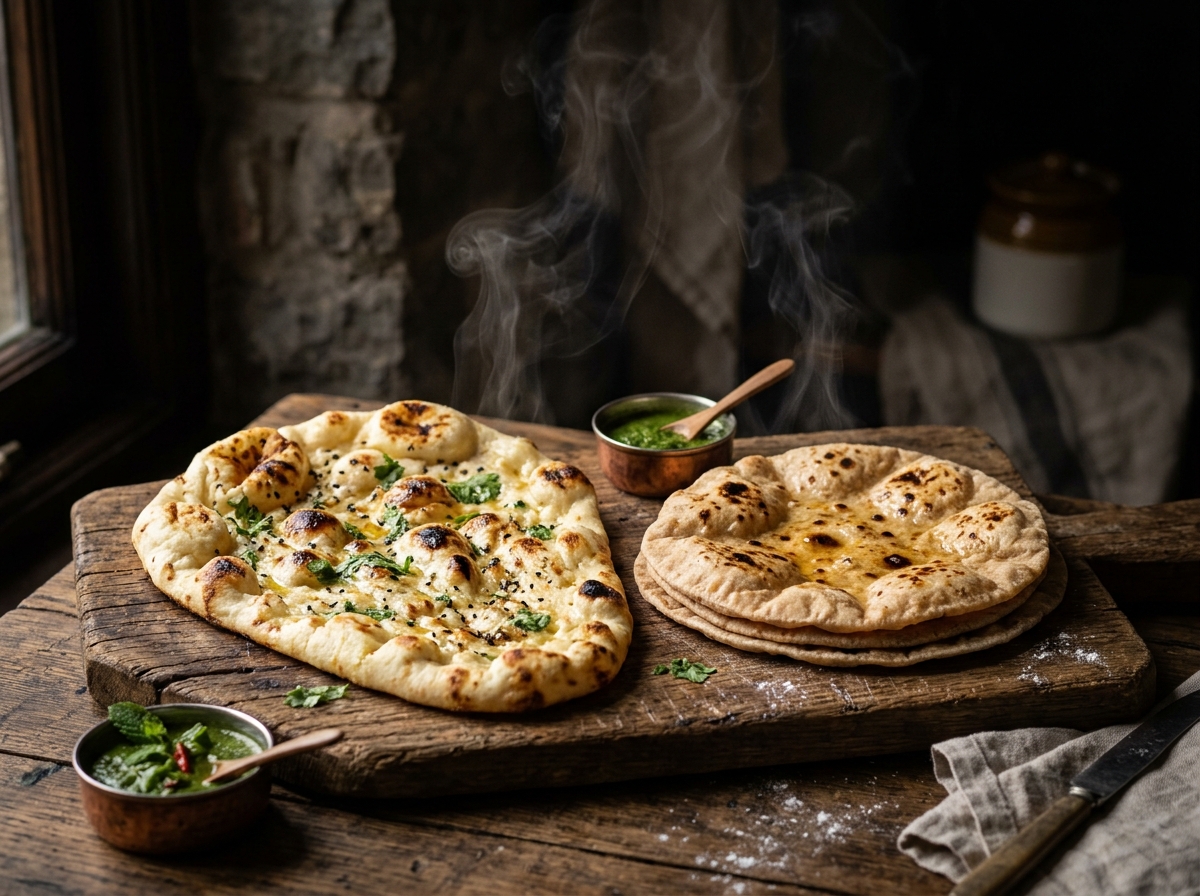
Naan vs Roti: Professional Baker’s Perspective on Indian Breads
Most people think Naan and Roti are interchangeable—just different names for Indian bread. Wrong. They’re completely different products made with different techniques, different hydration levels, and different equipment. Understanding this difference is crucial if you want to make them correctly at home.
At Rajmahal Palace and Mor Baug Jamnagar, I spent entire days in the bakery section. The naan baker worked a tandoor at 400°C. The roti maker worked a tava (griddle) at a much lower temperature. Different hands, different techniques, different philosophies. Yet most home cooks try to make both on a single tava or in a home oven and wonder why they don’t taste like restaurants.
Why did Naan and Roti go to therapy? Because they had identity confusion in every home kitchen 😂
Here’s the professional insight: Naan is leavened bread (it has yogurt and baking soda which create rise). Roti is unleavened and depends entirely on technique to puff. The moment you understand this fundamental difference, everything clicks into place.
Part 1: Authentic Naan (Tandoori Style)
- Prep Time: 20 minutes
- Rising Time: 4-6 hours (or overnight for deeper flavor)
- Shaping & Cooking: 20 minutes
- Total Time: 4-6 hours (plus overnight rising)
- Yield: 6-8 naans
Naan Ingredients
- 400 grams all-purpose flour (maida) or bread flour
- 150 grams full-fat yogurt
- 100 grams water (warm, roughly 40°C)
- 1 teaspoon instant yeast or ½ teaspoon dry yeast
- ½ teaspoon salt
- ½ teaspoon baking soda (helps with browning and puffing)
- 2 tablespoons oil or ghee
- 1 tablespoon sugar or honey (feeds the yeast)
- 1 tablespoon nigella seeds (kalonji) for topping
- 1 tablespoon fresh coriander for topping
- Butter or ghee for brushing after cooking
Naan Recipe Steps
- In a bowl, mix warm water (40°C) with instant yeast and honey. Let it sit for 5 minutes until foamy. This bloom activates the yeast and ensures even distribution.
- In a large bowl, combine flour and salt. Create a well in the center. Add the yeast mixture, yogurt, oil, and baking soda. Mix by hand until a shaggy dough forms. Don’t add all the water at once—yogurt provides liquid too.
- Knead the dough for 8-10 minutes until smooth, soft, and slightly sticky. The dough should bounce back slowly when poked—this is ideal for naan. If too dry, add 1 teaspoon water at a time. If too wet, dust with flour.
- Oil a bowl and place dough inside. Cover with a damp cloth. Let rise at room temperature for 4-6 hours, or overnight in the refrigerator (overnight is better for flavor). The dough should double in size and smell yeasty.
- Once risen, gently punch down the dough to release gas. Divide into 6-8 equal portions. Shape each into a ball. Cover loosely with a damp cloth for 10 minutes to relax the gluten.
- Working with one dough ball at a time, flatten it on a lightly oiled surface using your hands. Don’t use a rolling pin—use your hands to stretch the dough into an oval shape about ¼-inch thick. This hand-stretching creates better texture than a roller.
- Heat a cast-iron skillet or heavy-bottomed pan over high heat until it’s smoking hot (this simulates a tandoor at home). Place one naan on the hot pan. It should sizzle immediately and start puffing within 30 seconds.
- Cook for 2-3 minutes on the first side without moving it. Bubbles will form on the surface—this is exactly what you want. Flip and cook for another 1-2 minutes until light golden spots appear on both sides.
- Remove from pan and immediately brush generously with ghee or butter. Sprinkle nigella seeds and chopped coriander on one side. The residual heat will soften these toppings and help them adhere.
- Stack cooked naans on a plate or in a cloth-lined bowl to keep them warm. They’ll continue to soften slightly as they cool. Serve immediately with curries.
Part 2: Authentic Roti (Unleavened Bread)
- Prep Time: 10 minutes
- Resting Time: 20 minutes
- Cooking: 15 minutes (6-8 rotis at 2 minutes each)
- Total Time: 45 minutes
- Yield: 6-8 rotis
Roti Ingredients
- 300 grams whole wheat flour (atta)
- 150-160 grams warm water (adjust based on flour absorption)
- ½ teaspoon salt
- 2 tablespoons ghee or oil
- Extra dry flour for dusting
- Extra ghee or oil for cooking
Roti Recipe Steps
- Combine whole wheat flour and salt in a bowl. Create a well in the center. Slowly add warm water while mixing with your hand. Add water gradually—different flours absorb different amounts. You want a soft dough, not sticky.
- Knead for 5-8 minutes until smooth and silky. The dough should feel supple and elastic. Add 2 tablespoons ghee and knead again for 2 minutes until fully incorporated. The ghee creates layering and makes rotis flaky.
- Cover the dough and let it rest for 20 minutes. This rest allows the flour to fully hydrate and the gluten to relax, making the dough easier to roll and creating better texture in the final roti.
- Divide rested dough into 6-8 equal balls. Keep them covered with a damp cloth while working. Working with one ball at a time, flatten it slightly by hand, then roll with a rolling pin into a very thin circle—about 1/8-inch thick, ideally 7-8 inches in diameter.
- Heat a tava (Indian griddle) or cast-iron skillet over medium-high heat. The tava should be hot but not smoking—hotter than you’d use for pancakes but not as hot as for naan. Test with a drop of water; it should sizzle and evaporate quickly.
- Place a rolled roti on the hot tava. Let it sit for 30 seconds without moving. Small bubbles will start forming. This is normal. When you see bubbles, flip the roti gently.
- Cook the second side for 30-45 seconds. Then flip again. Now something magical should happen: if you watch closely, the roti should puff up like a balloon. This puffing is the goal—it means steam built up between the layers created by the ghee.
- If it puffs, that’s perfect—you’ve achieved the ideal. If it doesn’t puff, it’s still a good roti; it just won’t have that dramatic lift. This is honestly about technique and temperature balance, which takes practice.
- Remove from tava and immediately press gently with a cloth folded in half. Press all over to encourage puffing and even cooking. Brush immediately with ghee or butter.
- Stack cooked rotis in a cloth-lined bowl or plate to keep them warm. They’ll continue to soften slightly. Serve immediately with curries or dal.
Naan vs Roti: Professional Comparison
| Aspect | Naan | Roti |
| Leavening | Leavened (yeast + baking soda) | Unleavened (no yeast) |
| Flour | All-purpose or bread flour | Whole wheat flour (atta) |
| Rising Time | 4-6 hours or overnight | Only 20 minutes rest |
| Cooking Method | Very high heat (tandoor or cast iron) | Medium-high heat on tava/griddle |
| Puffing Mechanism | CO2 from yeast + steam from moisture | Steam trapped between flour layers |
| Texture | Soft, pillowy, slightly chewy inside | Thin, crispy-chewy, flaky layers |
| Shelf Life | Best eaten immediately, hardens quickly | Stays soft slightly longer than naan |
FAQ — Indian Bread Questions
Q: My Naan doesn’t puff. What’s wrong?
A: Several possibilities: yeast might be dead (check expiration), dough might not have risen enough (should double), or the pan isn’t hot enough (should be smoking). Also, making sure baking soda is included helps with browning and rise.
Q: My Roti doesn’t puff like restaurant roti. How do I fix this?
A: Puffing requires a balance: dough must be thin enough, pan must be at the right temperature (not too hot, not too cool), and timing must be precise. The flour-to-water ratio also matters—more ghee in the dough helps with puffing. This is honestly about practice and temperature intuition.
Q: Can I make Naan without overnight rising?
A: Yes, 4-6 hours at room temperature works. But overnight rising in the fridge develops more flavor and complexity. If you’re in a hurry, at least 4-6 hours is needed for yeast to do its job.
Save this recipe 📌
Which bread do you prefer—Naan or Roti? Or are you a “both” person? Tell me in the comments and let’s discuss your bread preferences!
Follow @cookingdepth on Instagram 📸 for daily street food inspiration and quick cooking hacks.
Pair these breads with Butter Chicken or serve with Dal Makhani.