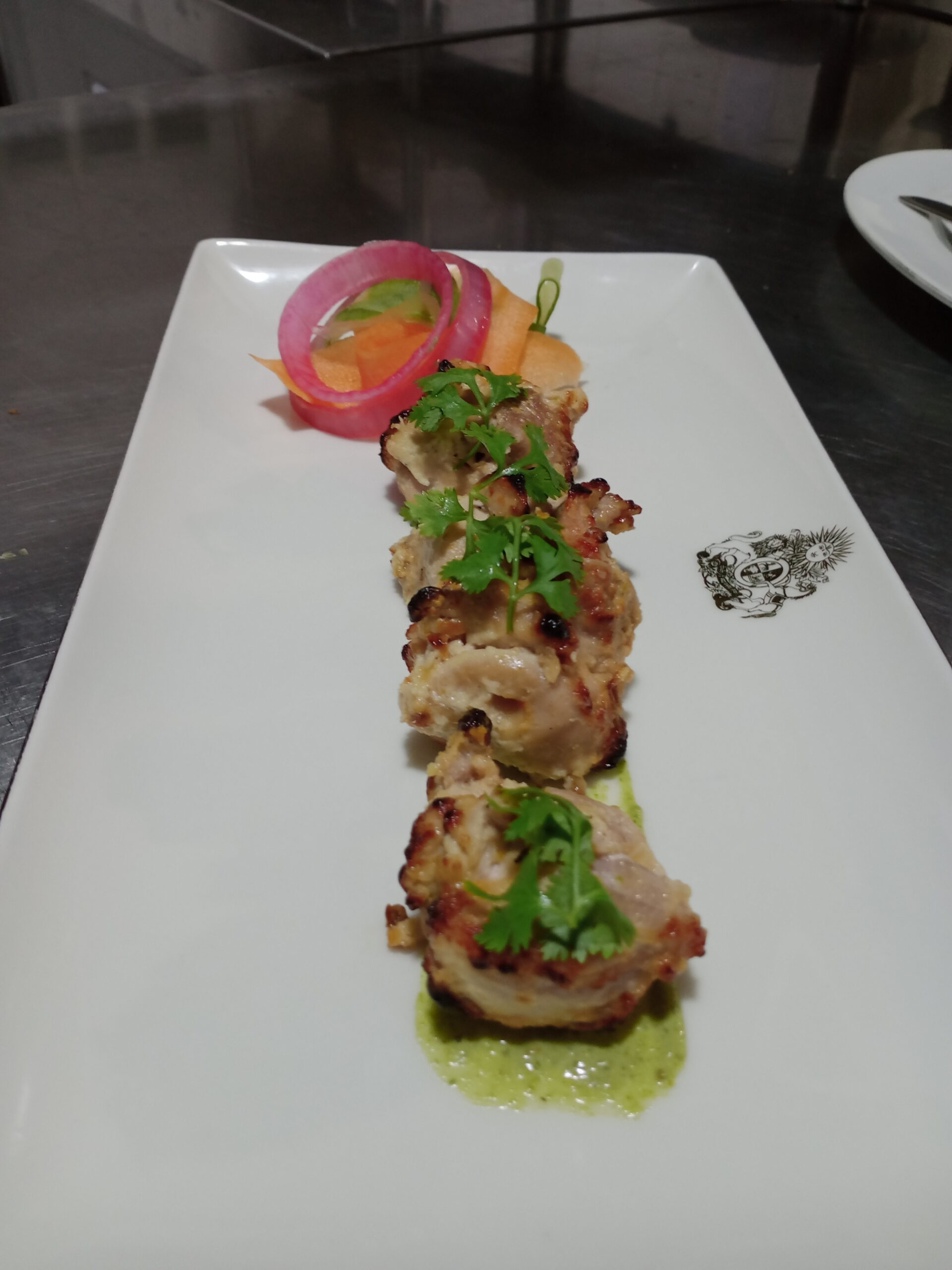
There’s a debate in the Indian food world that never seems to end: should we plate our food the way European fine dining restaurants do? Should a chicken tikka sit alone on a white plate with a swoosh of chutney and a microgreen garnish? Or should it be served the way our grandmothers served it — piled generously on a steel thali, with roti on the side and no thought given to negative space?
I’ve spent over ten years in luxury hotels where the answer was clearly the first option. At every hotel I’ve worked in — from Park Hyatt Goa to Jaipur Marriott to Rajmahal Palace — Indian food was plated with French precision. Dots of chutney placed with squeeze bottles. Tikka pieces arranged in odd numbers (always odd — it’s a plating rule). Pickled onion curls for height. Microgreens that cost more per gram than the chicken itself.
And I’ll be honest with you: sometimes it’s brilliant. And sometimes it completely misses the point.
What Hotel Plating Gets Right
First, the good stuff. Hotel training taught me to see food as a visual experience, not just a tasty one. Before my hotel career, I thought plating was about fitting everything on the plate. After a few months in a five-star kitchen, I understood that plating is about guiding the eye. Where do you want the guest to look first? What’s the hero of the dish? What’s the supporting cast?
Take a simple chicken tikka. At home, you’d put four or five pieces on a plate, add some sliced onion and lemon, and serve it with chutney on the side. Nothing wrong with that — it’s delicious. But in a hotel, we’d plate three pieces of tikka in a line on a rectangular white plate. A swoosh of green chutney underneath. Pickled onion and carrot curls at one end for contrast. A sprinkle of chaat masala for that final flavour hit. Fresh coriander — not scattered randomly, but placed specifically where the green would complement the char marks on the tikka.
The difference isn’t in the food — it’s in the intention. Home cooking says “here, eat.” Hotel plating says “here, look, then eat.” Both are valid. But there’s something powerful about making someone pause before their first bite, just to appreciate what’s in front of them.
Where Modern Plating Goes Wrong
Now, the honest part. I’ve seen Indian food plated so “modern” that it’s lost its identity. I’ve seen biryani deconstructed into separate components on a plate — rice here, gravy there, meat somewhere else — and thought: who is this for? Because it’s not for anyone who loves biryani. The whole point of biryani is that everything cooks together, the flavours marry in the dum, and every spoonful is different. Separating it is like taking apart a song and presenting each instrument individually. Technically interesting. Emotionally empty.
I’ve also seen dal makhani served in a shot glass as an amuse-bouche. Dal makhani. The dish that needs to simmer for hours, that’s meant to be eaten with hot naan, that’s supposed to be generous and comforting. In a shot glass. I wanted to call someone’s grandmother and report a crime.
The problem isn’t modernisation itself. The problem is when modernisation is done without understanding what makes the original dish great. If you don’t understand why biryani is layered, you shouldn’t deconstruct it. If you don’t understand why dal makhani is served in a bowl, you shouldn’t put it in a shot glass.
Finding the Balance
Over the years, I’ve developed my own philosophy about modern Indian plating. It’s simple: enhance the dish, don’t disguise it. A chicken tikka looks better on a clean plate with intentional garnishing than it does piled on a messy one. That’s enhancement. But a chicken tikka foam served in a pipette is a disgrace to tandoors everywhere. That’s disguise.
The techniques I borrowed from French plating and actually use regularly: negative space (don’t fill the entire plate), odd-number arrangements (three pieces look better than four), colour contrast (green chutney against orange tikka), and height variation (a pickled onion curl standing upright adds drama). These are universal visual principles, not French inventions. They work because our eyes are wired to find them appealing.
What I don’t do: molecular gastronomy on traditional dishes (no tandoori chicken spherification, please), unnecessary deconstruction, or plating that makes you need an instruction manual to eat your food. Indian food is generous by nature. It’s meant to be shared, piled on, eaten with your hands. Any modernisation that removes the generosity removes the soul.
A Chef’s Honest Take
Here’s what I believe: Indian cuisine doesn’t need European validation to be considered “fine dining.” Our food has always been complex, sophisticated, and deeply technical. The spice blending alone in a good garam masala is as complex as any French mother sauce. The technique of making a perfect roomali roti is as demanding as making puff pastry. We don’t need white plates and tweezers to prove our food is world-class.
But — and this is important — we can learn from other traditions without losing our own. Taking the French concept of plating with intention and applying it to Indian food doesn’t make the food French. It makes it more visible. It gives Indian cuisine a presentation language that communicates its quality to diners who might not yet understand its depth.
The best modern Indian restaurants — the ones I admire — do exactly this. They plate beautifully but don’t hide the food behind technique. You look at the plate and think “that’s a gorgeous tikka” not “that’s a gorgeous plate that happens to have tikka on it.” The food is still the hero. The plating just gives it a better stage.
So if you’re cooking Indian food at home and wondering whether to “plate up” — do it. Use a clean plate. Wipe the edges. Place your food with intention. Add a garnish that makes sense (coriander, a lime wedge, some sliced chilli). Take a moment to make it look beautiful. Not because Indian food needs to look European, but because beautiful food — in any tradition — deserves to be seen before it’s eaten.