Every year around April, something magical happens in Indian hotel kitchens. The mangoes arrive. Not the pale, imported ones that taste like vague suggestions of fruit. I’m talking about the real ones — Alphonso from Ratnagiri, Kesar from Gujarat, Dasheri from UP. Boxes and boxes of them, filling the cold storage with that unmistakable perfume that smells like sunshine decided to become a fruit.
And every year, the pastry section goes slightly insane. Because mango season is our Super Bowl. It’s the time when guests expect mango everything — mango mousse, mango cheesecake, mango tart, mango ice cream, mango kulfi. And we deliver, happily, because working with great mangoes is one of the genuine privileges of being a pastry chef in India.
The Discovery That Changed My Mango Game
It was during my time at one of the Goa hotels that I first paired mango with mascarpone. I was making a tiramisu — standard Italian recipe, mascarpone cream layered with coffee-soaked ladyfinger biscuits. And I had a batch of Alphonso purée sitting in the fridge from the morning’s production. On impulse, I folded some mango purée into the mascarpone cream. Just to taste. Just to see.
The first spoonful stopped me in my tracks. The mascarpone — rich, fatty, slightly tangy — was the perfect canvas for the mango. It didn’t compete with the fruit’s sweetness. Instead, it amplified it. The fat in the mascarpone carried the mango flavour across your palate in a way that cream alone couldn’t. And the slight acidity of both ingredients — mango’s natural tartness and mascarpone’s cultured tang — balanced each other beautifully.
There’s a moment in every chef’s career when two ingredients meet on your spoon and you think: where have you two been all my life? Mango and mascarpone was that moment for me. It was like introducing two friends who you just know are going to get along, and watching them become inseparable.
The Science of Why It Works
Let me geek out for a moment, because the food science here is genuinely interesting. Mango is high in natural sugars (fructose and glucose) and has a pH of around 3.5 to 4.5 — that’s moderately acidic. Mascarpone is a fresh Italian cheese with about 60 to 75 percent fat content and a mild acidity from the citric acid used in its production.
When you combine them, the fat in the mascarpone does two things. First, it rounds out the mango’s acidity, making it taste smoother and more luxurious. Second, fat is a flavour carrier — it binds with the volatile aromatic compounds in mango and releases them slowly as you eat, so the mango flavour lingers longer on your palate. This is why mango with cream tastes good, but mango with mascarpone tastes extraordinary — the higher fat content and the slight tanginess create a more complex flavour profile.
Compare this to pairing mango with heavy cream alone. Cream is rich but flavourless — it dilutes the mango rather than enhancing it. Mascarpone has character. It pushes back against the mango just enough to create tension, and that tension is what makes the combination exciting rather than just sweet.
Mango Season Memories from the Hotel Kitchen
During peak mango season, we’d go through thirty to forty kilos of Alphonso a week in the pastry kitchen alone. The prep was intense — peeling, pureeing, straining for seeds and fibres, adjusting sweetness batch by batch because every delivery was slightly different. One week the mangoes would be intensely sweet, the next they’d have more acidity. You had to taste constantly and adjust.
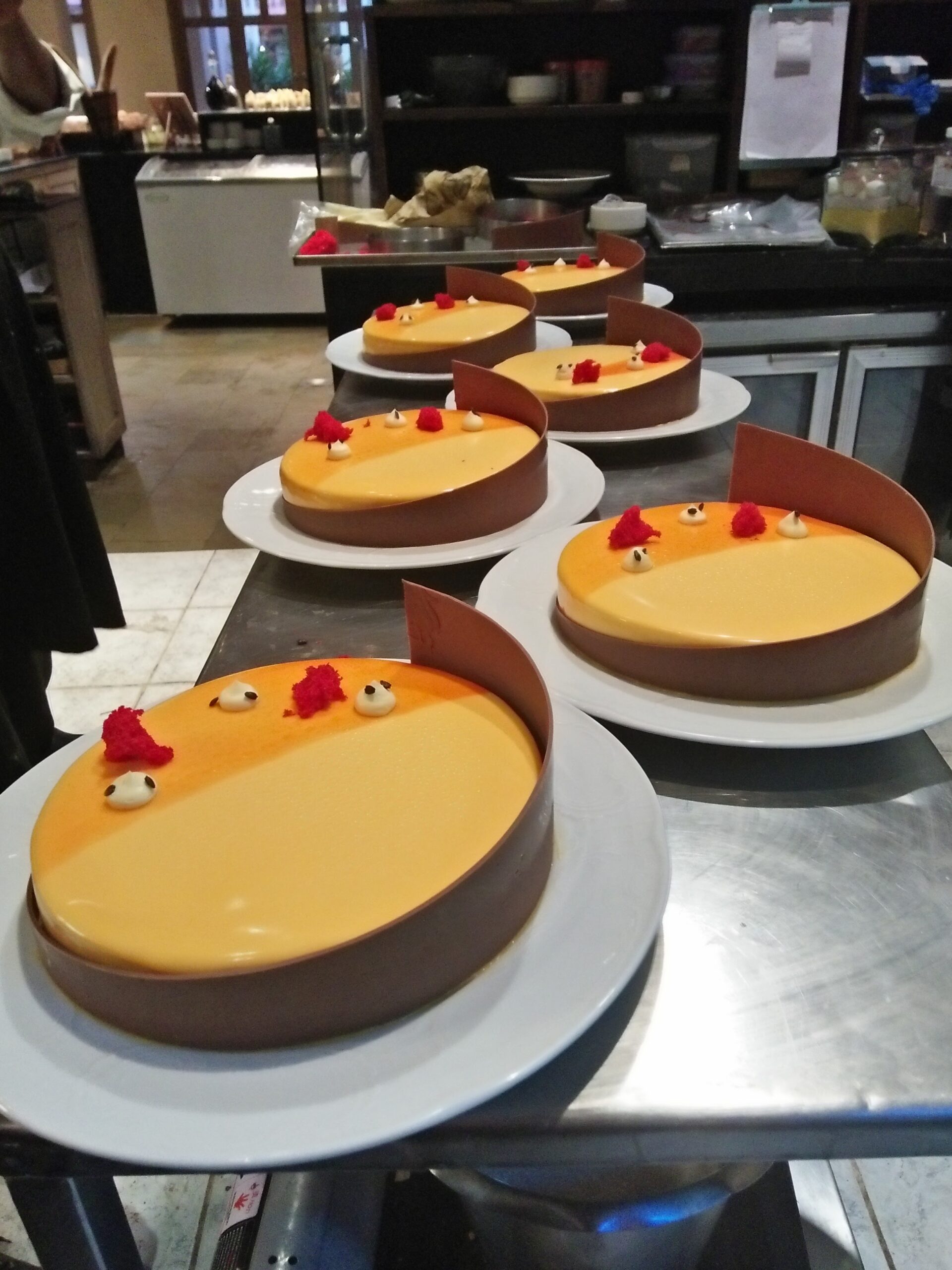
I remember one season when the Alphonso delivery was delayed by a week. The chef de cuisine came to the pastry section and said, “Guests are asking for mango desserts. What can you do?” We had Kesar mangoes instead — not as sweet as Alphonso, more floral, slightly fibrous. I made a Kesar mango mousse with a chocolate collar and a sable breton base. The Kesar’s floral notes actually worked better with the dark chocolate than Alphonso would have. Sometimes the backup plan is better than the original.
Those mango mousse cakes became a signature — we’d make dozens for the dessert buffet, each one with a precise chocolate collar wrapped around a perfect dome of set mango mousse. The colour alone was stunning — that deep saffron-orange of Alphonso against dark chocolate. No food colouring needed. Nature handled the aesthetics.
Making Mango Mascarpone Mousse at Home
Here’s a version you can make without professional equipment. Take 250 grams of good mascarpone (or fresh cream cheese as a substitute, though mascarpone is better). Whip it gently with 50 grams of icing sugar until smooth — don’t over-whip or it’ll split. Separately, whip 200 ml of cold heavy cream to soft peaks.
Take 200 grams of Alphonso mango purée — fresh is best, but good quality canned works in the off-season. Fold the mango purée into the mascarpone first, gently, until combined. Then fold in the whipped cream in two additions. The key word is fold — not stir, not mix, fold. You want to keep the air in the cream.
Pour into glasses or bowls, chill for at least two hours, and top with fresh mango cubes, a sprinkle of crushed pistachios, and if you’re feeling fancy, a tiny pinch of saffron threads. The contrast of the cold, creamy mousse with the fresh fruit on top is beautiful. Simple, elegant, and genuinely delicious.
If you want to go further, layer it like a tiramisu — mango purée-soaked sponge fingers, mango mascarpone cream, repeat. A mango tiramisu. It sounds unusual, but it works beautifully, and it’s become one of the desserts I’m asked to make most often.
The lesson mango season taught me is that Indian ingredients don’t need to be “elevated” by European techniques. They need to be paired intelligently. Mango doesn’t need mascarpone to be great — mango is already perfect. But mascarpone gives it a new context, a new stage to perform on. And together, they create something that neither could achieve alone. That’s not fusion for the sake of it. That’s just good cooking.