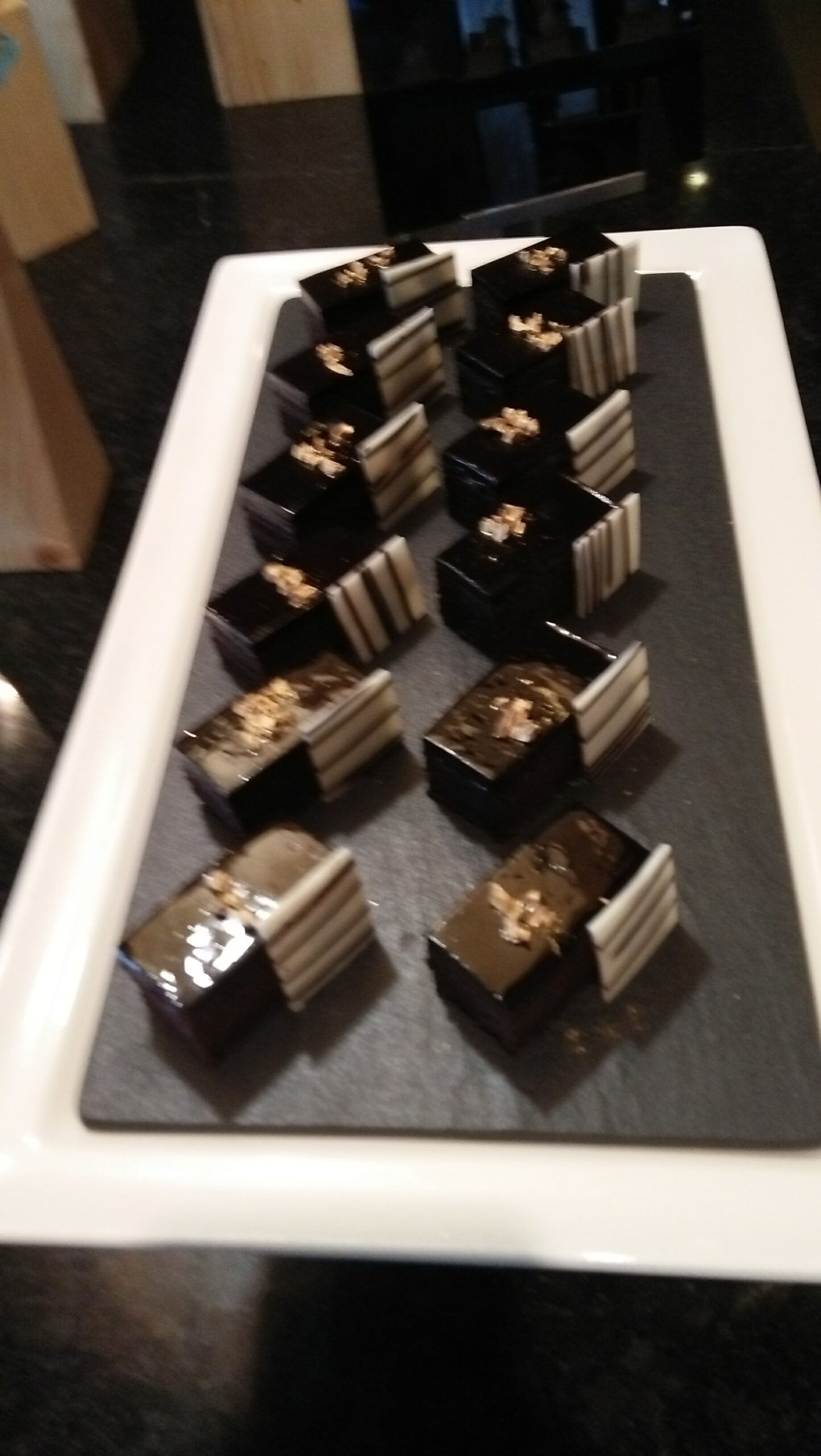
You know what separates a good pastry chef from a great one? It’s not the six-tier wedding cake or the show-stopping chocolate sculpture. It’s the tiny stuff. The petit fours. Those bite-sized, impossibly neat little confections that sit quietly on a tray at the end of a fine dining meal, looking like jewels and tasting like heaven. And let me tell you — they are the hardest thing I’ve ever had to master.
If you’ve ever wondered what are petit fours and why chefs obsess over them, buckle up. I’m about to take you inside the world of the smallest pastries with the biggest standards.
Why Small Means Difficult
Here’s the cruel truth about petit fours: at that size, there is nowhere to hide. A full-sized cake can have a slightly uneven layer and nobody notices. A croissant can be a little asymmetrical and it’s “rustic.” But a petit four that’s 3 centimetres square? Every millimetre of imperfection screams at you. The glaze has to be mirror-smooth. The layers have to be perfectly even. The cut has to be razor-clean. And every single one on the tray has to look identical to the others.
When I started making petit fours in my first hotel posting, my executive chef would inspect each tray with the intensity of a diamond cutter examining a stone. He’d pick up a single piece, turn it slowly, and if the glaze had a ripple or the cut was angled even slightly, the whole tray went back. Not that piece — the whole tray. “If one is wrong,” he told me, “the standard is wrong.”
That lesson stuck with me more than anything else I learned in those early years.
Petit fours don’t test your creativity. They test your discipline. And discipline is the thing most home bakers underestimate.
What Makes a Great Petit Four
Traditionally, petit fours fall into a few categories. Petit fours glacés are the classic ones — small pieces of cake or pastry coated in a smooth, poured fondant or chocolate glaze. Petit fours secs are dry cookies and biscuits, like tiny macarons or tuiles. And petit fours frais are fresh — think miniature tarts or cream-filled bites that need refrigeration.
In luxury hotels, we’d serve a mixed selection after dinner — usually on a tiered stand or a slate platter. The presentation had to tell a story: colours balanced, shapes varied, everything arranged with intention. It wasn’t just about taste. It was about creating a moment of wonder for the guest. When someone looks at a tray of perfect petit fours, they should feel like they’re looking at something crafted, not manufactured.
The flavour profile matters enormously too. Each piece is only one or two bites, so the flavour has to hit immediately. There’s no time for subtle build-up. It has to be instant impact — a burst of passion fruit, a clean snap of dark chocolate, a whisper of rose. You’re composing a miniature symphony in every bite.
What Petit Fours Taught Me About Being a Chef
Making petit fours day after day in a hotel kitchen taught me patience in a way nothing else could. You can’t rush the glaze — it has to be the exact right temperature (around 35°C for poured fondant, slightly cooler for chocolate) or it won’t set smoothly. You can’t rush the cutting — a warm, clean knife and a single decisive motion gives you a clean edge. Sawing back and forth gives you crumbs and regret.
It also taught me about consistency. In a hotel, a guest might order petit fours three nights in a row. Each time, they should look and taste exactly the same. Not similar — the same. This requires not just skill but systems: precise recipes, measured temperatures, standardised moulds. It’s where artistry meets engineering.
The precision I learned from petit fours carried into everything else I do. When I plate a dessert, I think in millimetres. When I temper chocolate, I watch the thermometer like a hawk. When I pipe, I aim for uniformity that would satisfy even that first chef who sent my trays back. These tiny pastries made me a better chef in every way.
Making Petit Fours at Home
If you want to try making petit fours at home, start simple. Bake a firm sponge cake — something like a génoise or an almond cake that holds its shape when cut. Level it, add a thin layer of jam or ganache, and chill it until it’s very firm. Then cut into precise squares or rectangles using a sharp knife dipped in hot water and wiped clean between cuts.
For the glaze, melt good-quality chocolate and thin it slightly with a neutral oil. Or make a simple poured fondant by heating fondant to 35°C with a splash of water. Place your cut pieces on a wire rack over a tray, and pour the glaze over each one in a single, confident motion. Let it drip, set, and resist the urge to touch it.
Will your first batch look like hotel petit fours? Absolutely not. Mine didn’t either. But the process of trying — of striving for perfection in something so small — will teach you more about pastry than a hundred YouTube tutorials ever could. The tiny pastry is the honest pastry. It shows you exactly where you are as a baker. And that honesty, uncomfortable as it sometimes is, is the fastest path to getting better.
Start small. Literally.