I was twenty-three years old, three years into my career, and I thought I knew what perfection meant. I could pipe a straight line of ganache. I could temper chocolate without a thermometer (or so I believed). I could make croissants that looked identical — or close enough that nobody would notice. I was proud of myself, and honestly, that pride was about to get a very necessary reality check.
It happened at Park Hyatt Goa. I’d recently joined, full of energy and full of the kind of confidence that comes from not knowing what you don’t know. The pastry kitchen there was beautiful — organised, well-equipped, and run by a senior chef who I’ll call Chef S. He was the kind of person who said very little but noticed absolutely everything.
The Welcome Platter Incident
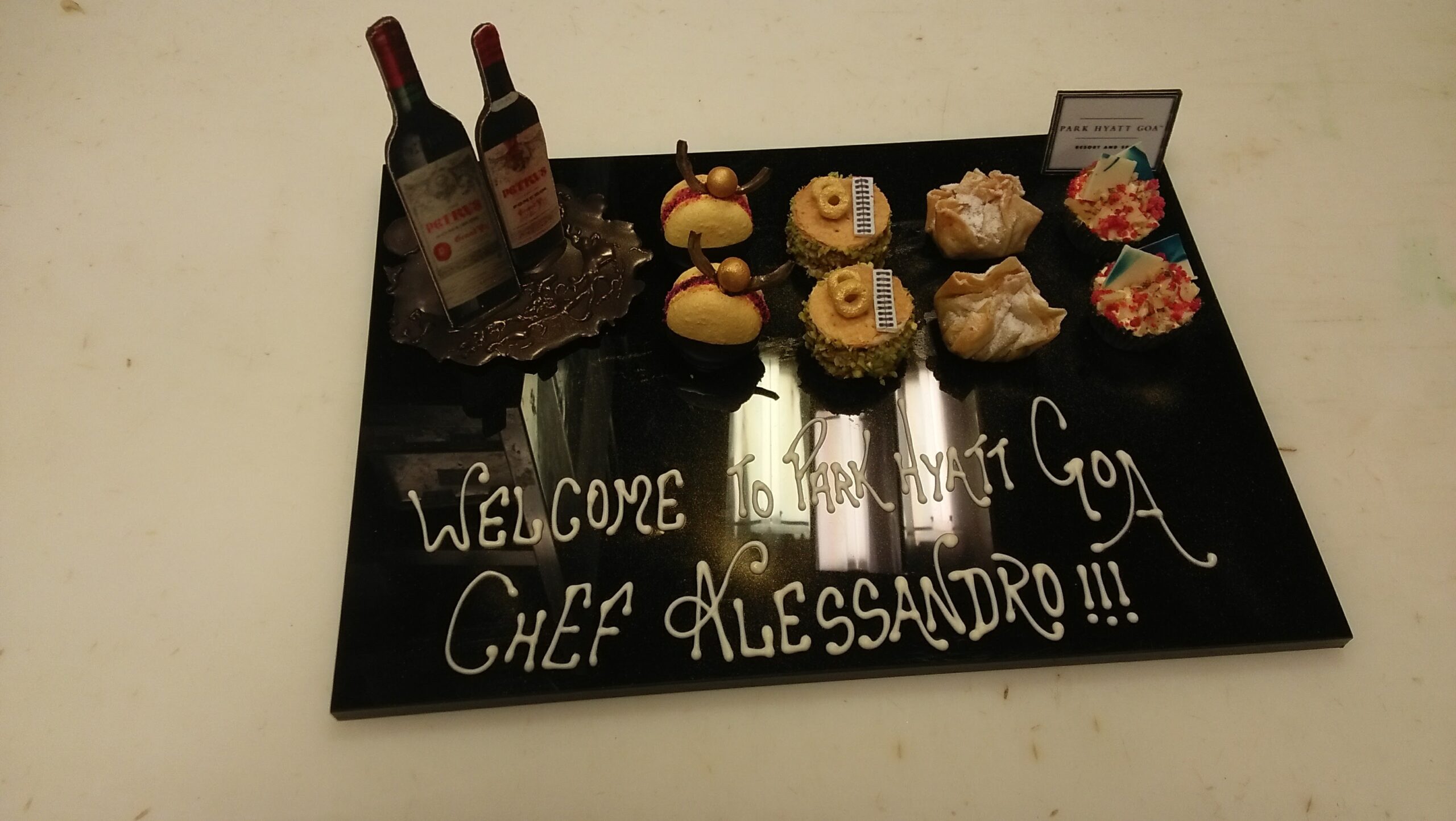
We had a visiting dignitary coming — another senior chef from the Hyatt group. When important guests arrived, we’d prepare a welcome amenity platter. Think of it as the hotel’s handshake — a carefully arranged selection of petit fours, pralines, and handcrafted chocolates, presented on a slate or mirror with a personalised message in chocolate writing.
I was given the job. I spent three hours on it. Hand-rolled truffles dusted with cocoa. Piped choux puffs with craquelin tops. Little tartlets with perfectly smooth lemon curd. I arranged everything symmetrically on a black slate, wrote the welcome message in white chocolate, and stepped back. I was genuinely pleased with myself.
Chef S came over, looked at the platter for about fifteen seconds — which felt like fifteen minutes — and said, “It’s good. But tell me, which piece would you eat first?”
I stared at him. I hadn’t thought about that. I’d thought about symmetry, colour contrast, height variation — all the things I’d been trained to consider. But I hadn’t thought about desire. About what would make someone reach for one piece before another.
“Perfection isn’t about making everything look the same, Giri. It’s about making someone feel something. If your platter doesn’t make someone’s hand reach out before their brain catches up — you’ve just made decoration, not food.”
He rearranged three pieces. Just three. Moved one truffle slightly forward — like it was leaning toward you. Angled a tartlet so you could see the glossy lemon curd catching the light. Put the tallest piece off-centre, breaking the symmetry I’d worked so hard to create. And suddenly, the platter came alive. It went from looking like a textbook photo to looking like an invitation.
What Perfection Actually Means
That moment changed my entire approach to pastry. I’d been trained in technique — lamination ratios, tempering curves, baking temperatures. And all of that matters. You can’t break rules you haven’t learned. But Chef S taught me that technique is the floor, not the ceiling.
Over the next few months, I watched him closely. He’d walk through the dessert buffet and move things. Never dramatically — a slight tilt of a cake stand, a sprig of mint placed where your eye would naturally land, a sauce drizzled in a way that told a story across the plate. He understood something that I was only beginning to grasp: food is an emotional experience, not just a visual one.
He also taught me about failure. One day, I overbaked a batch of financiers. They were dry, dark on the edges, and definitely not buffet-worthy. I was about to throw them out when he stopped me. “Taste one,” he said. I did. The flavour was actually deeper — the brown butter had gone further, the almond was more intense. “Now crumble it over ice cream,” he said. “You haven’t made a mistake. You’ve made a component.”
The Lesson That Stayed
I carried this thinking through every hotel I worked at after Park Hyatt. At Grand Hyatt, when a cake collapsed during service, I didn’t panic — I deconstructed it into a verrine. At Jaipur Marriott, when the mango delivery was overripe for our planned mousse, I turned them into a mango caramel instead. Better, actually, than the original plan.
Chef S wasn’t just teaching me about plating or about saving disasters. He was teaching me a philosophy: perfection isn’t a destination. It’s a direction. You keep moving toward it, knowing you’ll never fully arrive, and that’s okay. The striving is the point.
I see young chefs today who are terrified of mistakes. Social media has made everyone think that every plate has to look like it belongs in a Michelin-star restaurant. And I get it — I was that person too. But the best food I’ve ever made came from moments when things went slightly wrong and I had to think, adapt, and create something new.
Passing It Forward
Now, when I work with junior chefs, I try to pass on what Chef S gave me. I tell them: learn your technique until it’s muscle memory. Then forget about being perfect and start being honest. Put your personality on the plate. Make food that you would want to eat, not food that you think will get the most likes.
And sometimes, when they show me a platter they’re proud of, I ask them the same question: “Which piece would you eat first?” The look on their faces — that moment of realisation — it’s exactly how I must have looked all those years ago in the Park Hyatt kitchen.
Chef S retired a few years ago. I never told him properly how much he changed my career. Chefs are bad at saying things like that — we show love through food, not words. But if he’s reading this, I hope he knows: that fifteen-second pause in front of my welcome platter was worth more than any culinary school lecture I ever attended. Thank you, Chef.