
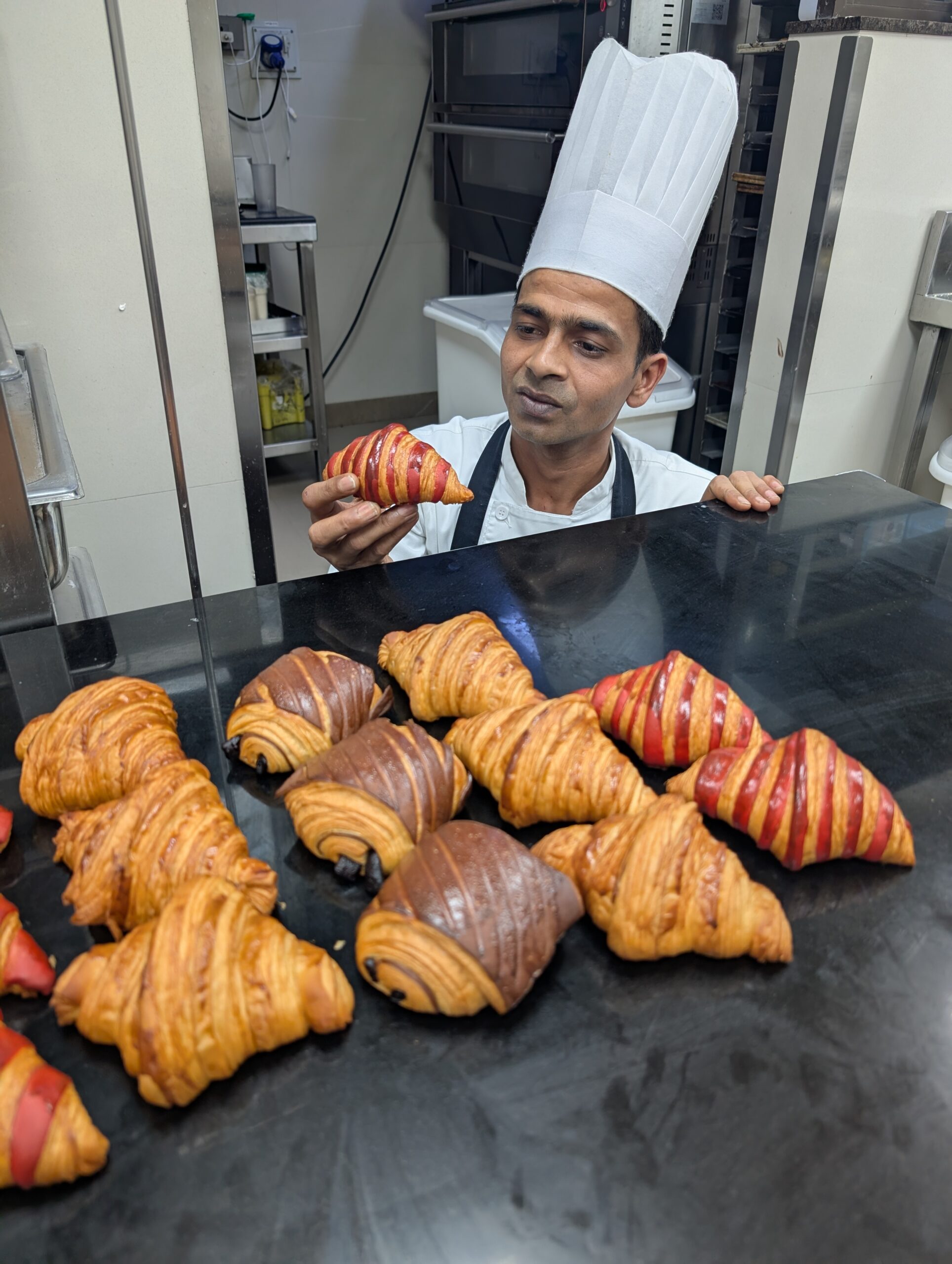
Masala Croissant — Indian Spice Meets French Lamination
What if you could combine a croissant’s butter-laminated layers with warming Indian spices? Masala croissants bridge two culinary traditions: French precision and Indian boldness. The challenge: infusing spice into butter without burning it, then maintaining lamination structure through six folds. This post shows exactly how to achieve both without compromising either tradition.
At a small fusion bakery in Delhi, I watched the pastry chef prepare masala croissants daily. She made spiced butter using carefully toasted garam masala, cumin, and chili—ground into powder, mixed with clarified butter at precise temperature. The lamination stayed intact because the spiced butter had identical melting point to regular butter. One insight: respect both traditions’ chemistry, don’t fight it.
Why did the masala croissant apply for a passport? Because it couldn’t decide between France and India 😂
Pro Tip: The key to spiced butter lamination is toasting spices gently (2-3 minutes) to bloom flavor without burning, then grinding to fine powder before mixing into softened butter. If spices are too coarse, lamination fails. If spices burn, bitterness overwhelms the buttery sweetness.
Understanding Spiced Butter Lamination
Croissant lamination creates flaky layers through butter’s melting point (32-35°C). Add ground spices and you still get layers—but now with flavor distribution throughout. The challenge: spice particles shouldn’t disrupt the fat matrix. Fine powder solves this by dispersing evenly through butter without breaking layers.
The Spiced Butter Creation Process
- Toast 3 tsp garam masala, 2 tsp cumin seeds, 1 tsp chili flakes for 2-3 minutes in dry pan
- Cool completely (5 minutes)
- Grind to fine powder using spice grinder or mortar and pestle
- Mix 250g unsalted butter (softened, not melted) with spice powder using spatula
- Spread on parchment, fold parchment in half, chill until butter disc is 1cm thick
- Spiced butter is ready for lamination sheets
Complete Masala Croissant Recipe (Makes 8)
Croissant Dough (24-hour process):
- 500g bread flour (high gluten)
- 300ml whole milk (warm)
- 75g sugar
- 10g sea salt
- 7g instant yeast
- 50g unsalted butter (for dough)
- 250g unsalted butter (spiced – see above)
Dough Technique (Day 1):
- Mix flour, salt, and yeast in large bowl (don’t mix salt and yeast directly)
- Warm milk to 30°C, add sugar, dissolve 50g butter into warm milk
- Add milk mixture to flour and mix until shaggy dough forms
- Knead 8 minutes by hand or 5 minutes in stand mixer until dough becomes smooth and elastic
- First rise in covered bowl at room temperature (23°C) for 2 hours until doubled
- Punch down gently, fold dough into thirds like a letter
- Wrap in plastic and refrigerate overnight (12-16 hours)
Lamination (Day 2):
- Remove dough from fridge, let rest 15 minutes at room temperature
- Roll dough into 30x20cm rectangle
- Spread spiced butter disc over center two-thirds of rectangle
- Fold unbuttered third over middle, then other third over top (business letter fold)
- Turn 90 degrees and roll to 30x20cm again
- Fold in thirds again (this is Turn 2)
- Wrap and chill 30 minutes
- Repeat rolling and folding 4 more times (6 turns total), chilling 30 minutes between each turn
- After final turn and chill, roll dough to 4mm thickness
- Cut into triangles (base 8cm, height 15cm)
Shaping and Baking:
- Roll each triangle from base toward point, creating crescent shape
- Place on parchment-lined baking sheet, cover loosely
- Second rise at room temperature 3-4 hours until visibly puffy
- Egg wash: brush with 1 beaten egg mixed with 1 tbsp water
- Bake at 200°C for 25-30 minutes until deep golden and flaky
- Cool on wire rack before serving
Why Six Folds Create Flakiness
Each fold doubles the layers. After six folds, you have 2^6 = 64 layers of butter and dough. These layers steam during baking, puffing apart and creating flakiness. Fewer folds = dense croissants. More folds = tough croissants (butter breaks). Six is the precision sweet spot.
Explore More Fusion Techniques
Master masala croissants, then explore tandoori salmon tart for savory fusion. Finally challenge yourself with gulab jamun brûlée to complete your Indian-French fusion repertoire.
FAQ: Croissant Lamination Rescue
Q: My croissants are dense, not flaky—what went wrong?
A: Insufficient folds or dough temperature too warm during lamination. Warm dough = butter melts into dough instead of creating layers. Chill between folds always.
Q: Can I make the spiced butter ahead?
A: Yes. Prepare 1 week ahead and refrigerate in airtight container. Let soften to 15°C before laminating (it should be pliable but not melting).
Q: What if my dough is dry after overnight rest?
A: Cover tightly. If still dry, add 1 tbsp water during rolling and it will distribute through lamination. Don’t add water to dough—this ruins layers.
Save This Recipe 📌
Croissant lamination is learnable but demands precision. Screenshot the six-fold diagram and the spice-toasting temperatures. Bookmark this post as your lamination bible.
Your Fusion Adventure
Have you ever imagined combining cuisines at this level? What other spice-butter combinations do you want to try? Indian? North African? Japanese? Tell me in comments and I’ll develop recipes for your fusion ideas.
Show Us Your Masala Croissants 📸
Tag @cookingdepth on Instagram with your laminated masala croissants. Shoot the cross-section to show those 64 golden layers. We feature the best flaky fusion shots.