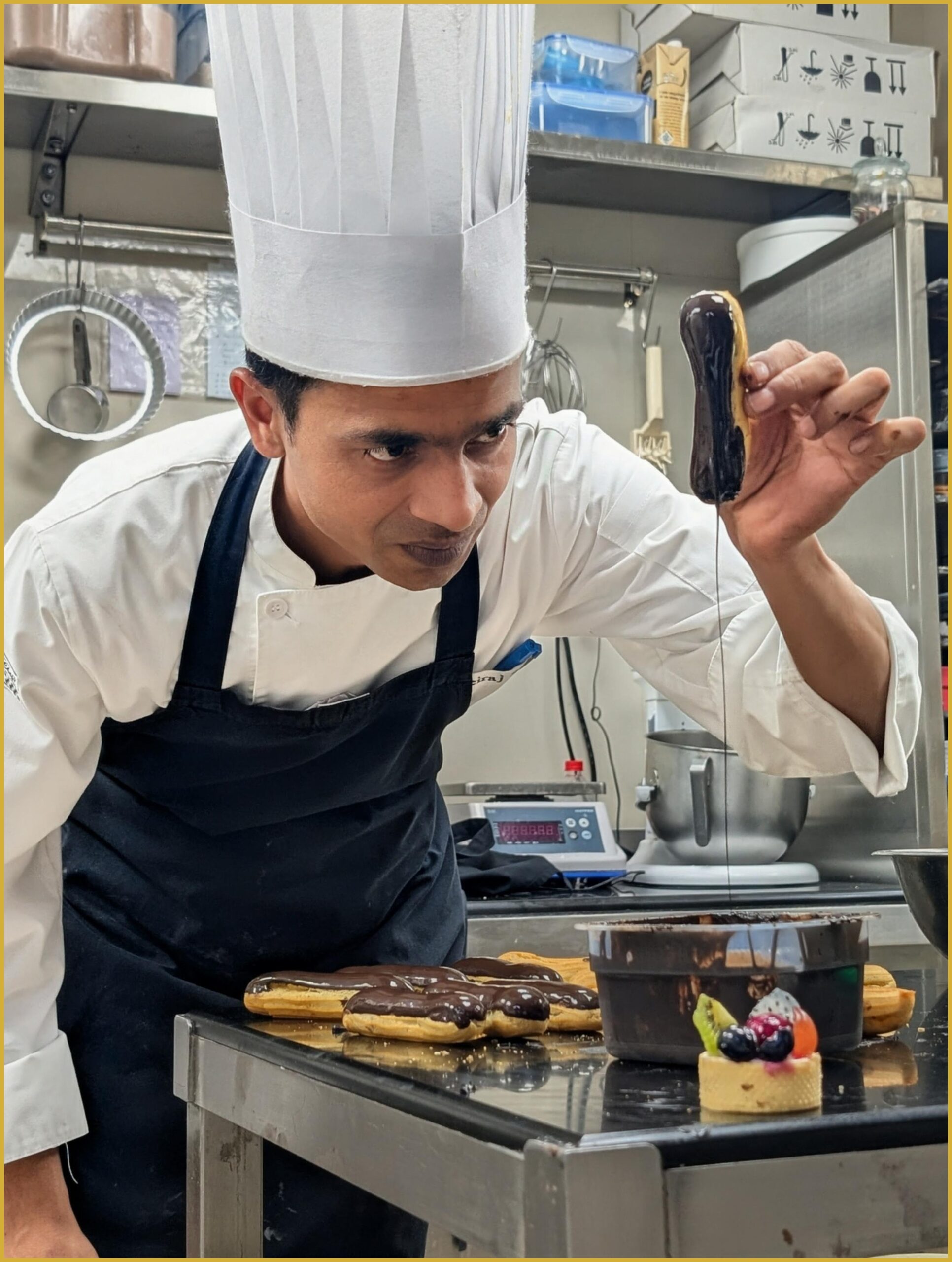
Same hands, same glaze, same precision — a split second later. The éclair catches the chocolate like silk catching light. Behind it, a fruit tartlet waits its turn. In a professional kitchen, beauty happens in sequence.
What a Sequence Shot Reveals
A single photograph of a finished éclair tells you the destination. A sequence shot — two frames separated by a fraction of a second — tells you the journey. In that narrow gap between the first frame and the second, you can read everything important about professional pastry work: the angle of the wrist, the speed of the dip, the moment the chocolate surface goes from broken to smooth, and the control it takes to make that transition look effortless.
The photograph captured here is not staged. It is not a reconstruction for the camera. It is an actual production moment in a working kitchen, and what it documents is one of the most important, least glamorous skills in all of pastry: the ability to repeat beauty with mechanical consistency.
The Éclair: A Deceptively Simple Canvas
An éclair begins as choux pastry — a cooked paste of water, butter, flour, and eggs that is piped into logs and baked until hollow. The shell must be dry and rigid, with a large internal cavity that can hold a generous quantity of cream filling. Getting the shell right requires understanding two critical moments in the baking process:
- The first phase (15–18 min at 200°C): Steam expansion fills and sets the structure. Do not open the oven door.
- The second phase (10–12 min at 170°C): The shell dries out and the walls firm. This is where underbaked éclairs collapse on cooling.
A correctly baked éclair sounds hollow when tapped on the bottom. It feels light for its size. The surface is deep amber, not pale gold. These are not aesthetic preferences — they are structural requirements. An underbaked shell will absorb the filling and go soft within the hour.
Glazing: Where Technique Becomes Visible
The glaze seen catching the light in this sequence is a fondant glaze or a chocolate glaze — in professional kitchens, both are used depending on the aesthetic intent. Fondant-glazed éclairs are the Parisian classic: smooth, opaque, often tinted with food coloring to signal flavor. Chocolate-glazed éclairs use a ganache or mirror-style glaze that behaves differently under the dip.
The dipping process looks simple. It is not:
- The glaze must be held at a precise working temperature — typically 30–32°C for fondant and 28–30°C for a set ganache glaze. Too cold and it drags. Too warm and it runs off entirely.
- The éclair is held by the ends, never touching the top surface, and dipped at a slight forward angle so the center of the top contacts the glaze surface first.
- It is drawn backward in a single smooth motion, not lifted straight up. The backward draw ensures the glaze distributes evenly to the edges and breaks cleanly without pulling a strand of glaze that would mar the surface.
- The excess is tapped off once, then the éclair is placed on a tray without adjustment. Attempting to fix a glaze after placement always makes it worse.
The Kitchen as Choreography
Notice the fruit tartlet visible in the background of this image, waiting its turn. This is kitchen choreography: multiple pieces in various stages of finishing, each waiting for its precise moment. In a professional pastry section during service, you might be glazing éclairs with one hand, monitoring a sugar syrup with the other, and directing a commis working on tuiles across the bench — all simultaneously.
The rhythm of a professional kitchen is not the frantic chaos that kitchen television tends to portray. At its best, it is closer to a manufacturing flow: each station working at its optimal pace, neither racing ahead to create bottlenecks downstream nor falling behind to create gaps in service. The pastry section, more than any other station, must operate on this principle because of the time-sensitive nature of set creams, glazes, and chocolate work.
The single most important quality we look for when hiring for the pastry section is not creativity — it is repeatability. Any skilled cook can make one beautiful éclair. The professional is the one who makes a hundred that look identical. Consistency is not the enemy of artistry. It is the foundation it stands on.
The Hands Tell the Story
In this sequence photograph, the hands are the subject. Not the éclair. Hands that have performed this motion thousands of times hold the éclair with a relaxed grip — not tight, not tentative. The wrist angle is the same for every piece. The speed is the same. The moment of withdrawal is the same.
This is what training builds: muscle memory that overrides fatigue. At the end of a 14-hour kitchen day, when the conscious mind is tired and attention has frayed, the hands still know what to do. They have done it so many times that the body itself has become the recipe.
Behind the Beauty: The Production Reality
Behind this moment of captured elegance is a production reality that most guests never see. The éclairs were baked in batches of 30–40 at a time. The filling — a pastry cream (crème pâtissière) stabilized with additional gelatin or butter for structure — was made in a batch large enough to fill the full tray, then strained and chilled. Each shell was pierced on the base at three points to receive a piping tip, filled until resistance was felt, then turned for glazing.
The glaze was made fresh that morning, tempered or adjusted to the correct Brix level (sugar concentration) for the desired set and sheen, and held in a bain-marie throughout service to maintain temperature. A thermometer is not a suggestion in this work — it is the difference between a glaze that holds for three hours and one that weeps before it reaches the pass.
Sequencing as Philosophy
The title of this post borrows from the image: beauty happens in sequence. This is true in the literal sense — the éclair, then the tartlet, then whatever follows — but it is also a philosophy of professional kitchen work. Nothing significant in a pastry kitchen is made in a single step. Everything is a sequence: recipe into mise en place, mise en place into component, component into assembly, assembly into service.
Learning to think in sequences — to see the full chain of steps before beginning the first one — is the skill that separates a cook who can follow a recipe from a pastry chef who can build a menu.
In the fraction of a second between these two frames, there is a whole career’s worth of learning. That is what this photograph is really about.
#SequenceShot #ChocolateGlaze #EclairDip #KitchenFlow #ChefHands #GlazingProcess #PastrySequence #BehindTheScenes #KitchenRhythm #ProfessionalPastry