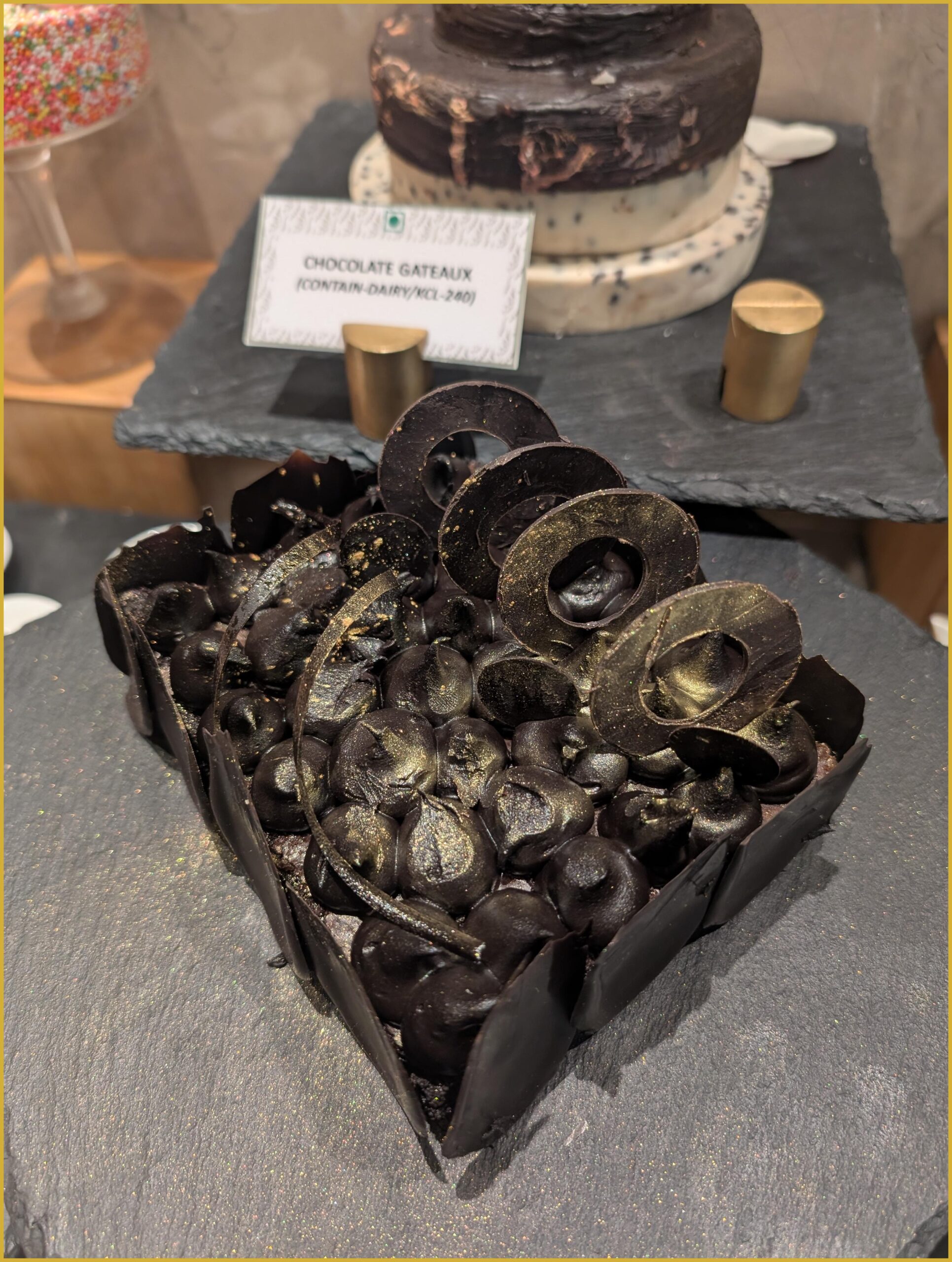
Dark chocolate entremet wrapped in tempered chocolate panels. Gold-dusted ganache domes piped with millimeter precision. Curved chocolate sculptures rising from the top like abstract art in an edible gallery. This is what happens when a pastry chef thinks like an architect.
What Is an Entremet?
The word entremet comes from the French — literally, “between servings” — a term once used for elaborate decorative dishes presented between courses at royal banquets. In the modern pastry kitchen, an entremet is a composed, multi-layered mousse cake, typically assembled upside-down inside a ring mold and then unmolded and finished with extraordinary precision. It is among the most technically demanding things a pastry chef produces, requiring mastery of textures, temperatures, gelatin ratios, tempering, and visual composition simultaneously.
The entremet in this image is not a cake in any ordinary sense. It is architecture in chocolate.
The Language of Layers
Every entremet is built around a conversation between textures. Where a simple cake offers sponge and frosting, an entremet might contain:
- A dacquoise or sablé base — providing crunch and structural support
- A crunchy feuilletine insert — pailleté feuilletine mixed with praline paste, delivering contrast at the center
- A cremeux or ganache core — dense, glossy, intensely flavored
- A primary mousse layer — aerated, light, setting with gelatin to hold shape
- A mirror glaze or chocolate panel exterior — the final surface that defines visual identity
The architect’s challenge: each layer must be at the correct temperature before the next is added. Pour a warm mousse onto a cold insert and it melts the gelatin. Add a glaze to a mousse that has not fully set and it collapses. The entremet is assembled in stages, each requiring freezing or chilling cycles, and the entire process can span two to three days for a single cake.
Tempered Chocolate Panels: Engineering at 1mm
The exterior of this cake is wrapped in tempered dark chocolate panels — thin sheets of chocolate that have been brought through a precise heating and cooling cycle to encourage the correct crystalline form of cocoa butter (Form V, or Beta crystals). Tempered chocolate is harder, glossier, and contracts cleanly as it sets, which allows it to be cut into precise shapes, wrapped around cakes, or manipulated into sculptural forms.
To make the panels:
- Dark chocolate (70%+ cocoa) is melted to 50–55°C, destroying all existing crystal structures
- Cooled to 27–28°C (seeding method or tabling) to begin forming stable Beta crystals
- Warmed back to 31–32°C — the working window where only Form V crystals are stable
- Spread onto acetate at precisely 1–2mm thickness, patterned if desired, then wrapped around the cake before full crystallization
Miss the temperature window by two degrees and the chocolate blooms — turning pale and matte. Get it right and the result is a surface with the kind of deep, reflective gloss you see in this image: a finish so clean it reads like lacquer.
Gold Dust and Ganache Domes: The Visual Vocabulary
The ganache domes on top of this entremet are not random decoration. They are a deliberate compositional choice. Each dome is piped from a tempered ganache that has been aerated or set to a pipeable consistency, then dusted with edible gold powder — not gold leaf, but an ultra-fine metallic dust applied with a soft brush in directional strokes.
Gold in pastry is not kitsch. Used correctly, it communicates value and elevates the perception of what the guest is about to eat. It also directs the eye: the gold domes lead you upward toward the sculptural elements rising from the top of the cake, creating vertical movement that transforms a square form into something dynamic.
When we build an entremet, the final decoration is planned before the first layer is poured. Every element — the panel width, the dome spacing, the sculpture height — is sketched on paper first. A cake assembled without a design intent ends up looking busy rather than composed. The restraint in decoration is as important as the technique.
Curved Chocolate Sculptures: When Pastry Reaches for Art
The curved chocolate pieces rising from the top of this entremet are made from cigarettes or tuiles of tempered chocolate — thin sheets pulled from acetate while still pliable and draped over forms to set into curves. This is the most expressive part of the work, where the chef transitions from technician to artist.
The curve of each piece is deliberate: slightly asymmetric, echoing organic forms found in nature rather than the strict geometry of the chocolate panels below. This tension — between the architectural rigidity of the cake and the organic freedom of the decoration — is what gives the entremet its visual intelligence.
The Science Beneath the Aesthetics
Great entremets are never purely aesthetic exercises. Every visual decision is grounded in technique:
The square form of this cake is not arbitrary — it is harder to achieve clean right-angle cuts with a mousse-based cake than a round, and the precision required communicates mastery. The dark chocolate palette is chosen for its natural visual depth; dark chocolate reflects light differently than milk, creating the sense that the surface has dimension even before any decoration is applied. The matte-to-gloss contrast between the gold domes and the chocolate panels creates a visual hierarchy that tells the guest’s eye where to look first.
Why This Matters Beyond the Kitchen
An entremet at this level takes a trained pastry team approximately 12–16 hours of hands-on work, spread across multiple days. It cannot be rushed. It cannot be improvised. And it cannot be faked — the materials and the physics simply will not allow it.
What you see in this photograph is not just a beautiful dessert. It is the visible result of years of training, thousands of practice attempts, and a fundamental belief that food made with this level of care is worth the time. In a world where most desserts are assembled from pre-made components, this kind of craftsmanship is increasingly rare — and increasingly meaningful.
Pastry chefs who build entremets like this are not just cooks. They are architects of experience.
#ChocolateEntremet #SquareCake #TemperedChocolate #GanacheDomes #ChocolateSculpture #GoldDust #DarkChocolate #EntremetsArt #ChocolateArchitecture #LuxuryCake